Ceiling crane
The overhead crane has a bridge or two parallel structural bridges that move horizontally along the warehouse or hall within a defined range. and has six movements up-down, left-right and front-back. Generally, overhead cranes are used in various industries for the purpose of loading and moving products and machines or as a tool for heavy equipment repairs.
Overhead crane specifications include various categories, for example, the number of overhead crane bridges is one of its characteristics. One bridge and two bridges are the most common types of cranes in terms of the number of bridges. Another feature of the overhead crane is its towing wire or chain. Usually, wire rope cranes are used for higher tonnages of overhead cranes. Talking about the tonnage, it can be said that the most important characteristic of cranes that distinguishes them from each other is the tonnage of the cranes. The conventional tonnages of overhead cranes include 500 kg, 1, 3, 5, 8, 10, 15 and 20 tons. is Two-stage or four-stage overhead crane winch, or single-speed and two-speed, are other practical features of overhead cranes.
In the construction of overhead cranes, it is generally such that they are like a bridge that moves on two parallel horizontal rails that are installed at the appropriate height along the length of the walls of the hall or industrial shed or storage warehouse, so that it can be moved. Create the load in the longitudinal axis. A movable hydraulic carriage is placed in the upper or lower part of this bridge so that it moves along the bridge in the transverse axis of the hall and makes it possible to access the crane in the transverse axis. But the most important function of a crane is the ability to lift heavy objects from the ground. For this purpose, a pulley is installed in the central part of the carriage that folds and unfolds a metal cable for suitable heights. The end of this metal cable will be connected to the crane hook set to allow the overhead crane to lift, move, move and implement heavy loads. If there are no suitable columns for the implementation and installation of overhead cranes, special support structures or gantry cranes can be used.
Application of ceiling crane
This type of workshop overhead crane, which is considered a type of mobile crane, is used in warehouses, industrial halls, sheds and other closed environments and generally in workshop roofs to move heavy loads that are difficult for humans to carry. This model of cranes works best in indoor places with a large opening and will be able to meet the needs of the employer and workers to move wide, heavy loads that require frequent movements by combining the movement of the main structure along the longitudinal axis with the movement of the overhead crane carriage. along the transverse axis and the metal cable in height. Various industries use these overhead cranes in their work process. Automotive industries, heavy equipment, shipbuilding, power plants, aviation, metal and concrete manufacturing, transportation equipment manufacturing, etc. are among the uses that can be mentioned for this useful tool. The weight of the load and the number of times the device is supposed to be used during the day are very important in choosing the type of crane. The width of the workshop opening and height should also be taken into consideration.
The benefits of using a ceiling crane
Reduction of work costs: A roof crane can be even more useful than several forklifts, so it will be more economical both in terms of fuel consumption and the number of manpower. In addition, because it can operate at a high height and without the need to have a commuting route, it avoids wasting time. The height of the installation makes it possible for employers and workers to use it at any level. Sometimes forklifts may not be able to raise the load to the desired height or lift the load from a height beyond their capacity, but there is no such limitation in the overhead crane.
Reduction of human error: Due to the fact that it will be very difficult for human power to lift heavy objects, there will always be a possibility of injury to it and also to the workers engaged in this work. By using a suitable overhead crane, such incidents can be avoided altogether. Workshops, sheds, factories and other similar environments are built, compared to other types of cranes, they have higher resistance against possible damage and their maintenance and repair costs are compared to other types of cranes. It is lower.
Complete access in three dimensions: Due to the movement of this crane along the longitudinal, transverse and height axes, this crane alone can cover the entire working environment and Completely eliminate the need for other types of lifting or heavy lifting. A overhead crane can lift heavy objects from the entire shed and transfer them to any other place in the shed. No need for technicians or special forces: overhead crane with a remote control. It's a very easy to control hand that doesn't require any special skills or watching a special course to move it. Simply hook the load to it to lift and then unhook once it's in place. With a few times of practice without load, you can easily learn to control an overhead crane.
Positioning ability: Overhead cranes can be equipped with an advanced positioning system and can also be given Pre-prepared programs also used their automatic functions.
Ceiling cranes
Single-bridge overhead crane (monorail)
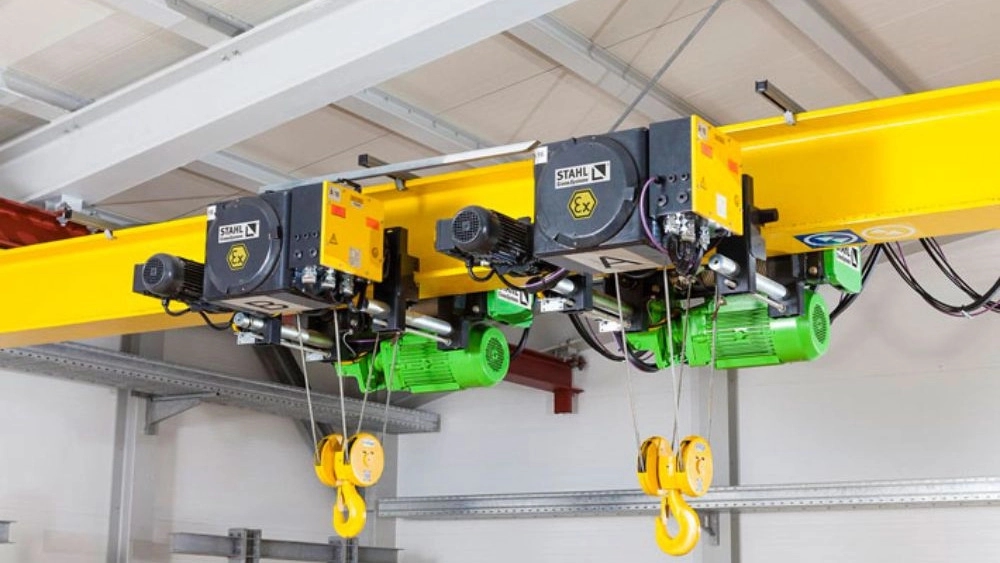
In the construction of a single-bridge crane, as the name suggests, there is only one bridge. This means that only a transverse horizontal beam-like structure moves on rails and longitudinal beams. In this type of overhead cranes, transverse rails are installed on both sides of the bridge and support the carriage track. Single bridge overhead cranes are suitable for spans less than 20 meters and are suitable for lifting and moving loads with a maximum weight of 20 tons. This model allows the maximum use of the interior space in the halls that have a complex structure. In this type of overhead cranes, unnecessary costs can be reduced as much as possible by complying with standards and reducing dead weight. This is also very important on the pressure exerted on the single bridge crane rails because in fact all the weight of the used cargo will be concentrated and imposed on one bridge. However, the cost of maintenance and repairs of this type of overhead cranes is much lower than the pair of flowers.
Double bridge overhead crane (two bridges)
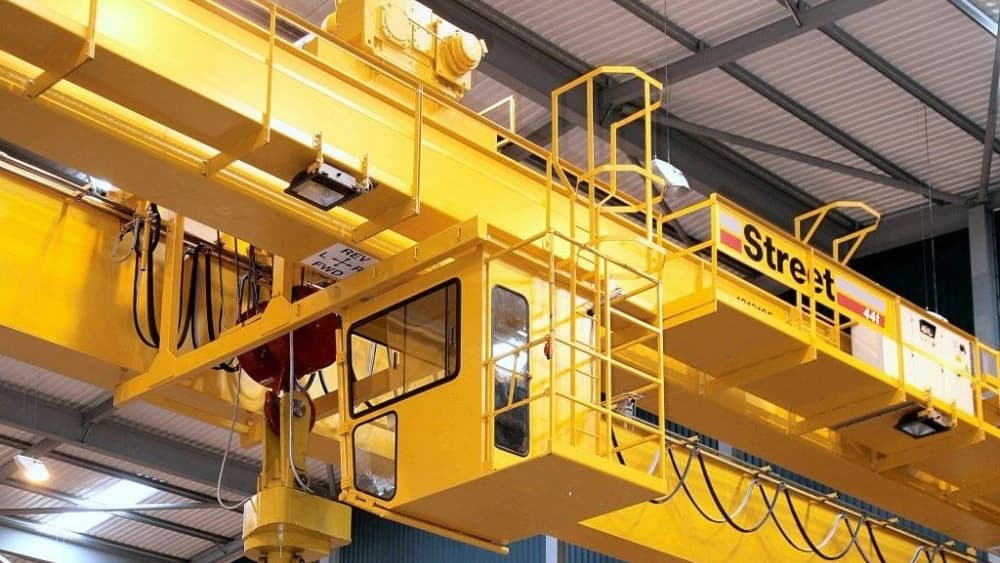
It goes without saying that in this type of overhead cranes, instead of one bridge, two bridges are used, which are like two connected beams. They appear together with an empty space between them. In the double bridge overhead crane, transverse rails are placed on the bridge and the carriage rides on them from above and connects the cables to the hook set from the empty space between the two bridges. Therefore, it has a high weight carrying capacity compared to a single bridge overhead crane. A double bridge overhead crane can lift and move up to 320 tons of weight. This type of overhead cranes is suitable for moving large loads in large facilities. Definitely, if the employer wants to move cargo at a high height, it is recommended to use this model of overhead cranes. Also, if the opening of the workshop is more than 25 meters, it will not be possible to use the single-bridge model, so you must definitely use a double-bridge overhead crane.